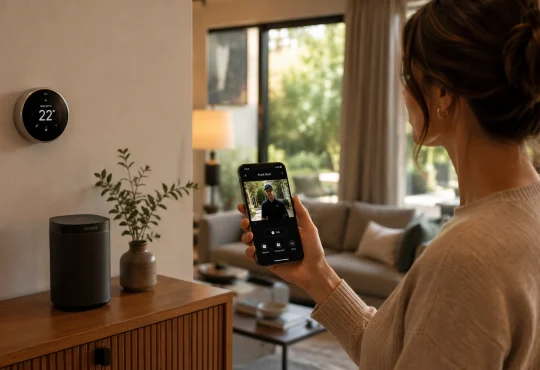


Not because something is wrong. It’s just telling you the milk is “running low” even though you clearly bought a new carton two days ago. You stand there for a second, looking at the notification on your phone, wondering when your refrigerator became another thing that needs attention at night.
This is usually the moment people realise a smart refrigerator isn’t just a normal appliance with extra features. It’s a connected refrigerator sitting inside a wider IoT refrigerator ecosystem that keeps track of food, usage, and sometimes habits in ways that feel helpful on paper… and slightly overactive in real life.
That gap between expectation and experience is what defines most AI refrigerator searches today. Some users want a smart fridge that quietly handles things like food inventory tracking and grocery list automation. Others end up questioning why their smart kitchen appliances are sending alerts they didn’t ask for in the first place.

What a Smart Refrigerator Actually Does
A smart refrigerator (also called a connected refrigerator or part of a smart home refrigerator system) is a traditional fridge with added sensors, connectivity, and software features.

Most modern models combine:
- internal cameras for checking contents remotely
- AI systems for food inventory tracking
- integration with voice assistants like Alexa or Google Assistant
- touchscreen panels for apps, notes, and controls
- alerts for food expiration tracking
- syncing with smart fridge grocery list automation tools
In broader setups, they’re part of an AI smart home kitchen, where appliances are connected through a shared ecosystem.
But here’s the key detail: most “smart” behavior is assistive, not autonomous. The fridge doesn’t manage your kitchen. It supports tracking and reminders based on input and sensors.
How a Smart Refrigerator Actually Works Day to Day
Most people don’t interact with a smart refrigerator by thinking about “systems” or “AI models”. It starts much simpler. You open the door. You close it. You forget what you saw inside five minutes later.
That’s where the system starts working in the background.
When you place items inside a connected refrigerator, sensors quietly register changes. Some models use internal cameras in a refrigerator with an internal camera setup, snapping images of what’s inside. Others rely on manual input through apps tied to smart fridge grocery list automation tools.
Nothing dramatic happens at first. It’s small data points:
- Door opened
- Item added
- Item removed
- Temperature adjusted
Then the system starts building patterns.
If you’re using an AI fridge food inventory tracking feature, the fridge begins estimating what you have based on past input and usage behaviour. It may suggest that milk is low, even if it’s still there. Or it may remind you of items that were already consumed but never logged properly.
This is where things start feeling less like a passive appliance and more like a system that “thinks” in approximations.
From there, the data usually moves into a companion app. That’s where the smart fridge food expiration tracking shows up. You might get a notification saying something like “use soon” or “running low,” depending on how the system interprets usage patterns.
If your setup includes voice integration, a voice control refrigerator (Alexa/Google Assistant integration) lets you interact without opening the app. You can add items to a list while cooking or check what’s inside while shopping.
But here’s the reality most people notice after a while:
The fridge doesn’t truly manage your kitchen. It reacts to it.
The more accurate your input, the more useful the system becomes. The less you interact with it, the more “guess-based” the experience feels.
That’s the core of how a smart home refrigerator system actually operates in daily life. It’s not automation in the strict sense. It’s assisted tracking layered over a traditional appliance.
Where Smart Refrigerators Actually Work Well
This is where expectations finally match reality.
A smart fridge works best in situations like:
- busy households where grocery tracking gets messy
- shared homes where multiple people buy food separately
- users already invested in smart kitchen appliances
- people trying to reduce food waste with reminders
- homes using integrated AI kitchen assistant appliance systems
The biggest real-world benefit is not automation. It’s visibility.
Instead of guessing what’s inside the fridge, you get structured reminders and tracking. That alone can reduce duplicate purchases and forgotten items.
Some models also claim improvements in energy usage through energy-efficient smart refrigerator systems that adjust cooling cycles based on usage patterns. Results vary, but efficiency optimization is part of newer designs.

Who Smart Refrigerators Actually Work Best For
High-fit users (where smart fridges make sense)
This is where a smart refrigerator actually earns its place.
The strongest use case is households that already struggle with coordination. Think busy families where groceries get duplicated, forgotten, or wasted. In that environment, AI fridge food inventory tracking and smart fridge grocery list automation actually reduce friction instead of adding it.
A typical example:
- Multiple people buying groceries separately
- no shared system for tracking what’s already in the fridge
- Food gets forgotten in the back and expires
Here, a connected refrigerator helps because it creates a shared reference point. Everyone sees the same inventory. Everyone updates the same list. The system becomes useful because the household problem already exists.
Another strong fit is tech-integrated homes. If someone is already using smart kitchen appliances, voice assistants, and home automation routines, a smart home refrigerator system fits into that ecosystem naturally. The fridge isn’t an isolated gadget. It becomes another node in a connected setup.
Medium-fit users (works, but not essential)
This group gets some value, but not enough to justify the upgrade on features alone.
Shared apartments fall here. A smart fridge vs. a regular fridge comparison in this case usually comes down to coordination. The fridge can help track shared groceries, but people still rely on messaging apps or habits anyway.
You’ll see partial use of:
- smart fridge food expiration tracking
- internal cameras for quick checks
- occasional voice commands
But usage tends to be inconsistent. People try the features, then drift back to manual behaviour.
The system helps, but it doesn’t fundamentally change how they manage food.
Low-fit users (where it becomes unnecessary)
This is where most buying regret tends to happen.
Single-person households or users with simple routines rarely benefit from a smart fridge. The tracking features become redundant because the person already knows what they bought and when they used it.
In these cases:
- AI refrigerator features get ignored
- Apps stop being opened after initial setup
- Notifications start feeling unnecessary
- The fridge becomes a normal appliance with extra software running in the background
This is also where questions like “Are smart refrigerators worth it?” usually come from. The mismatch is not technical. It’s lifestyle-based.
Problems with Smart Refrigerators
Where Smart Refrigerators Start to Break Down in Practice
Most smart refrigerators don’t fail in obvious ways. They don’t stop cooling. They don’t suddenly stop working. What happens instead is quieter. The features slowly become less useful over time or harder to trust in daily use.
That’s where the gap appears between expectation and reality.
1. Privacy concerns (it’s not just “data collection”)
A smart fridge privacy concerns issue isn’t just about abstract data usage. It comes down to what is actually being recorded and where it goes.
In models with internal cameras or cloud sync, images of fridge contents may be stored or processed externally. That means household usage patterns can be tied to account systems you don’t actively think about after setup.
The consequence is simple:
People stop using certain features because they’re not comfortable with always-on tracking, even if the feature itself is useful.
So instead of improving convenience, the system gets partially abandoned.
2. Software dependency (when the fridge outlives its intelligence)
A major smart refrigerator lifespan issue doesn’t show up in the hardware. It shows up in the software.
The fridge still cools normally. Nothing changes physically. But the app stops updating properly, or support for older systems becomes limited.
The consequence:
Features like AI fridge food inventory tracking or smart fridge grocery list automation quietly degrade over time.
So the fridge becomes something strange:
A fully functional appliance with partially broken intelligence layered on top.
3. Over-notification fatigue (useful becomes annoying)
A smart fridge food expiration tracking system is designed to reduce waste. But in real usage, it often produces frequent reminders that don’t always match reality.
Milk still fine → “use soon” alert
Food already used → still listed in inventory
Minor changes → repeated notifications
The consequence:
Users start ignoring alerts completely.
Once that happens, even the useful notifications lose impact because everything gets treated the same.
4. Cost vs actual usage (the underused feature problem)
A smart refrigerator often sells on features like touchscreen panels, cameras, and AI systems. But real usage tends to concentrate on basic functions.
Most households end up using:
- cooling
- occasional app checks
- basic reminders
Meanwhile, advanced features like a voice control refrigerator (Alexa / Google Assistant integration) or an AI kitchen assistant appliance tool get used briefly and then fade out.
The consequence:
You’re effectively paying for a system where only a fraction of the functionality becomes part of daily life.
5. Energy savings (not always what it sounds like)
Marketing often highlights energy-efficient smart refrigerator features. Some models do adjust cooling cycles based on usage patterns.
But in real-world conditions, savings are often inconsistent. Door habits, load size, and environment matter more than software optimisation in many cases.
The consequence:
Users assume meaningful savings, but in practice, the difference compared to a regular efficient fridge is often minimal.
Smart Fridge vs Regular Fridge Comparison
A smart fridge vs. a regular fridge comparison usually comes down to priorities.
Regular fridge:
- simpler systems
- fewer failure points
- longer predictable lifespan
- no software dependency
Smart refrigerator:
- inventory tracking and reminders
- remote monitoring
- integration with smart home systems
- higher upfront cost and complexity
One focuses on reliability. The other focuses on convenience and data.
The Real Decision Factor (What Most Articles Miss)
Most people don’t actually need a smart fridge.
They benefit from it only if:
- They actively use digital tools in daily life
- They struggle with food tracking or waste
- They already use smart home systems
Otherwise, the features become passive. Interesting at first. Ignored later.
This is why search behaviour splits so sharply between AI refrigerator excitement and smart fridge skepticism.
Conclusion: Smart Refrigerators as a Decision
So, are smart refrigerators actually worth it?
The honest answer depends less on the technology and more on how your kitchen actually runs day to day.
A smart refrigerator works best when it’s solving a real coordination problem. If your home has multiple people buying groceries, forgetting items, or struggling to track what’s already inside, then features like AI fridge food inventory tracking and smart fridge grocery list automation can genuinely reduce friction. In that situation, the fridge becomes part of a working system, not just an appliance with extra features.
But if your routine is simple, the value drops quickly. A single-user household or someone who already has stable grocery habits usually doesn’t benefit much from a connected refrigerator. Most advanced features end up unused, and the fridge behaves like a standard appliance with additional software running quietly in the background.
Final takeaway
A smart refrigerator is worth considering only when it solves a specific problem you already have. If it doesn’t, most of its “smart” features will quietly fade into the background while it just… becomes a normal fridge with extra software running in it.